


-(52).png)
-(50).png)
-(48).png)
-(53).png)
How to Tell the Difference Between...
I recently spoke with one of my health coaching clients. Her goal...
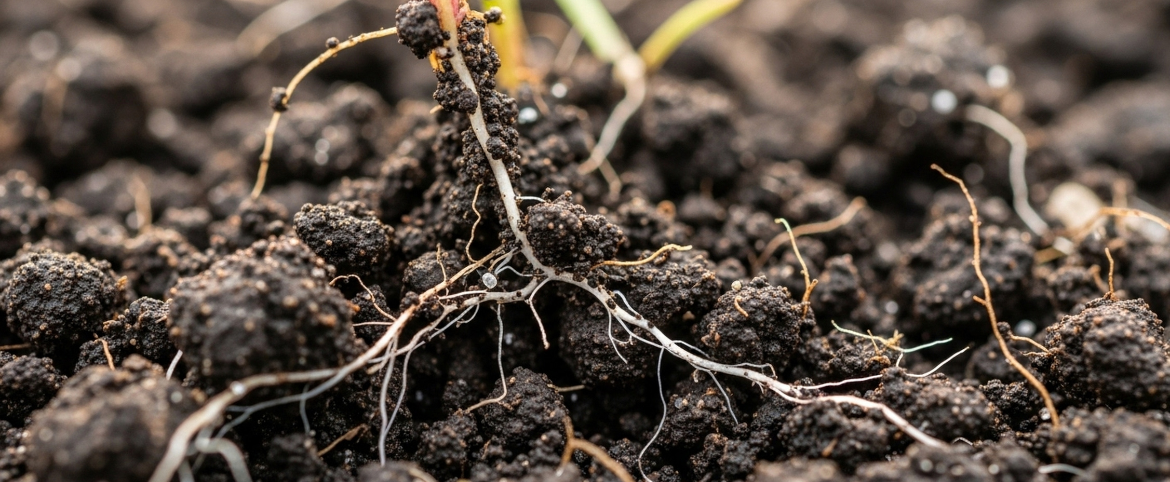
AI-driven solutions are emerging as powerful tools to enhance farmland soil health and promote sustainable agricultural practices. AI's role in agriculture extends to optimizing resource use, improving decision-making, and enabling more precise farming methods. Key applications include:
1. Geospatial Imagery for Landscape-Level Planning
AI models leveraging geospatial data can analyze land-cover-land-use changes, soil health, and water availability across vast land areas. This enables holistic management and regeneration of natural resources, aiding in the planning of regenerative landscapes.
2. AI-Enabled Digital Extension
Regenerative agriculture often relies on tailored practices from research institutions. AI, particularly large language models (LLMs) combined with Retrieval-Augmented Generation (RAG) models, can provide farm-specific advice based on localized data. This makes knowledge dissemination more cost-effective and accessible, especially with AI-enabled language translations.
3. Pest Prediction for Reduced Pesticide Use
AI solutions utilizing image recognition and hyperspectral imagery can enable predictive and preemptive pest detection. This optimization of pesticide use is crucial for regenerative agriculture, which aims to gradually reduce chemical inputs.
4. AI-Enabled Financial Incentives
Financial incentives are vital for encouraging the shift to regenerative agriculture. AI-enabled smart contracts and geospatial data-driven AI models can measure carbon sequestration remotely, making payments faster, error-free, and cost-effective.
5. Rapid Soil Tests and Monitoring
AI-enabled soil testing provides quick assessments of soil health, facilitating precise decisions on the effectiveness of regenerative practices. Additionally, geospatial AI models can monitor practices like intercropping or cover cropping at scale, and enable farmer segmentation for customized support.
One of the companies in our portfolio models which is doing a great deal of work in this space is ABB.
ABB
ABB's AI Solutions for Agriculture and Soil Management
ABB, in collaboration with partners like Microsoft, has been developing and implementing AI-driven solutions to address challenges in agriculture, particularly focusing on data-driven practices to optimize resources and enhance sustainability. While not exclusively focused on soil, these solutions indirectly contribute to soil health through optimized farming practices.
FarmBeats Project
One notable initiative is the FarmBeats project, which leverages IoT (Internet of Things) and AI to provide data-driven insights to farmers. This project has demonstrated significant improvements in agricultural productivity and resource management:
•Soil Monitoring: A key aspect of FarmBeats involves deploying networks of sensors in fields to monitor crucial soil parameters such as temperature, humidity, and acidity. This real-time data allows farmers to make informed decisions regarding irrigation, fertilization, and pest management.
•Pest Prevention and Erosion Control: By continuously monitoring soil conditions, farmers can proactively manage pests and implement strategies to prevent soil erosion, both of which are vital for maintaining long-term soil health.
•Water Management: The system enables careful monitoring of soil water retention, allowing farmers to adjust their water budgets and optimize irrigation, leading to reduced water intake and more sustainable water use.
•Data Accessibility: Recognizing the challenges of connectivity in rural areas, the FarmBeats project has innovated data delivery mechanisms. For instance, in some trials, sensor data was transmitted using the 'white space' in television signals to an Edge device, which then uploaded it to the cloud. This ensures that even farmers without reliable Wi-Fi access can benefit from data-driven insights.
•Increased Yields: Trials have shown that farmers following data-driven recommendations from the FarmBeats program, particularly on aspects like optimal sowing time, ideal sowing depth, and fertilizer quantities, experienced a significant increase in their yields (e.g., 30% increase in some cases).
•Predictive Models: The datasets generated from these programs are used to build more effective predictive models. Once sufficient data is collected, AI and machine learning applications can create site-specific solutions for individual farms, promoting sustainable and cost-effective practices.
ABB's involvement in such initiatives highlights their commitment to leveraging advanced technologies like AI and IoT to transform agriculture, making it more efficient, productive, and environmentally sound.
Other Companies' AI Solutions for Soil Health
Beyond ABB, numerous companies and startups are leveraging AI to address soil health and sustainability challenges. These innovations span various aspects of agriculture, from soil monitoring and analysis to precision farming and sustainable resource management.
1. Azolla Projects
Azolla Projects utilizes AI, data science, and satellite imagery to advance regenerative agriculture. Their tools help farmers measure soil health, optimize irrigation, and boost biodiversity. Their online dashboard employs machine learning models to predict soil organic carbon (SOC), facilitating the adoption of sustainable practices.
2. Indigo Ag
Indigo Ag focuses on microbiology and digital technologies to enhance farmer profitability and reduce environmental impact. They enable sustainable agriculture by helping farmers produce high-quality carbon credits while optimizing soil health.
3. Trace Genomics
Trace Genomics has developed an advanced analytics engine to map the living soil. They provide actionable insights for improving soil health and crop productivity through targeted genomics-based data, allowing for a deeper understanding of the soil microbiome.
4. FarmWise
FarmWise builds autonomous weeding robots that use computer vision to identify and remove weeds without harming crops. This technology promotes sustainable soil management by significantly reducing the need for chemical herbicides.
5. Terramera
Terramera's nanotechnology-based Actigate platform delivers plant-based active ingredients to crops more efficiently. This reduces dependency on chemical pesticides and enhances soil microbiomes, contributing to healthier soil ecosystems.
6. Solinftec
Solinftec combines AI and IoT to provide real-time agricultural insights. Their solutions help farmers improve productivity while maintaining soil integrity and environmental balance through optimized resource management.
7. CropX Technologies
CropX specializes in data-driven farming, using IoT and machine learning to optimize irrigation and boost yields. Their technology ensures precise water application across fields, conserving resources and improving soil quality by preventing over- or under-irrigation.
8. The Yield Technology Solutions
The Yield's IoT-powered system collects data on weather, soil moisture, and crop conditions, offering predictive insights to help farmers improve soil and crop health sustainably. This allows for proactive management and better decision-making.
9. Soil Scout
Soil Scout offers underground wireless sensors that monitor soil moisture and other conditions. This enables precision agriculture practices that enhance soil management by providing real-time, localized data.
10. Ceres Imaging
Ceres Imaging uses aerial imagery to provide farmers with insights into water stress, plant health, and nutrient levels. Their tools empower growers to optimize soil and resource use through detailed visual analysis.
11. AgriCapture
AgriCapture certifies climate-friendly farming practices, helping producers monetize sustainable management techniques. Their cover crop projects actively improve soil health and carbon sequestration, contributing to both environmental and economic benefits.
Conclusion
Artificial intelligence is poised to revolutionize agriculture, offering unprecedented opportunities to enhance farmland soil health and promote sustainable practices. From advanced sensor networks and geospatial analysis to predictive modeling and robotic automation, AI-driven solutions empower farmers with the insights and tools needed to optimize resource use, reduce environmental impact, and improve productivity. Companies like ABB, through initiatives such as FarmBeats, are demonstrating the tangible benefits of integrating AI into agricultural operations, particularly in soil monitoring, water management, and yield optimization. Furthermore, a growing ecosystem of innovative companies and startups is contributing to this transformation, each bringing unique AI-powered approaches to address specific challenges in soil health and regenerative agriculture. As these technologies continue to evolve, they hold immense promise for creating a more resilient, efficient, and environmentally friendly agricultural future, ensuring the long-term health and fertility of our farmlands.
Taken together, in an approach that makes sense financially, economically and environmentally, these AI-based solutions can go a long way to reaching 10% sustainability enhancements in soil health to be able to create the carbon sequestration needed to capture all carbon emissions from human and industrial activity globally.
Image source: Flixx Studio
Note: The views expressed here do not exclusively represent the views of Materia+ and governing entities.
Check out these recently published articles on Materia+.
I recently spoke with one of my health coaching clients. Her goal...
Nettle may be one of the most infamous plant medicines that I’ve...
Yoga, an ancient practice combining physical postures, breathing exercises, and meditation, has...
I had the amazing privilege of doing a group agricultural study abroad,...